AI search visibility: what it is, and how to check whether AI names your business
AI search visibility is how often AI answers name your business when buyers ask. How to check yours by hand, and why a clean website can still go unnamed.
The short answer
AI search visibility is how often AI assistants name your business when someone asks the kind of question your buyers ask. Think ChatGPT, Gemini, Perplexity, Claude, Copilot and Google's AI Overviews (the AI summary above some Google results). It is a rate, not a position: "named in 4 of 15 answers", not "ranked third".
To check yours, ask several AI assistants the questions your customers ask, without typing your business name. Ask each question more than once, on different days. Count how often you are named out of all the answers, and who is named instead. Then check that your website's settings do not keep AI search out.
Improving it is often called GEO, generative engine optimisation, a term from a research paper first posted on 16 November 2023 and accepted at KDD 2024, a major data-science research conference. "AEO" (answer engine optimisation) and "AI SEO" are used for much the same work.
Why does AI search visibility matter?
Because for some buyers, the answer is the shortlist. If an assistant names three businesses, the rest may never come up.
One study found people click fewer links when an AI summary is on the page. Pew Research Center studied the Google searches of 900 US adults in March 2025 (published 22 July 2025): "Users who encountered an AI summary clicked on a traditional search result link in 8% of all visits", against 15% without a summary.
It covers Google only, in one country, and does not measure what happens to the businesses an answer names. But when fewer people click past the answer, what the answer says matters more.
What are the two parts of AI search visibility?
It helps to split it into two questions, because you control one and not the other.
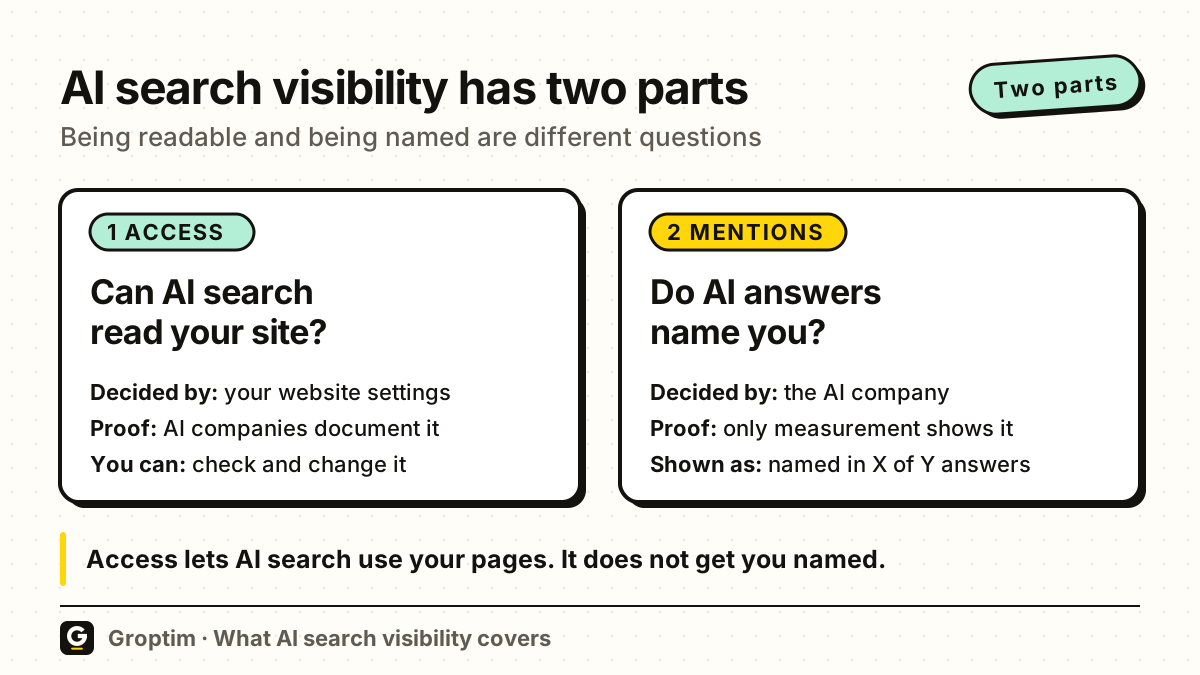
| Part | The plain question | Who decides | How well it is proven |
|---|---|---|---|
| Access | Can AI search read your site? | Your website settings | Documented guidance: the AI companies say so themselves |
| Mentions | Do AI answers name you? | The AI company, answer by answer | Measurement: only counting answers shows where you stand |
Access is documented. OpenAI: "Sites that are opted out of OAI-SearchBot will not be shown in ChatGPT search answers, though can still appear as navigational links" (crawler documentation, undated, checked 13 October 2026). OAI-SearchBot is the automated reader behind ChatGPT's search. Navigational links are plain links to a site, separate from the answer text. Google: "To be eligible to be shown as a supporting link in AI Overviews or AI Mode, a page must be indexed and eligible to be shown in Google Search with a snippet" (AI features and your website, updated 10 December 2025). Indexed means Google has stored the page; a snippet is the short text under a search result.
Mentions are not a setting. Open access makes your pages eligible for AI search answers. It does not make you chosen.
We have seen that gap on a real site. In a full audit of a young software website we call Site X, run on 10 October 2026, all 16 website checks passed. Yet AI answers to 7 general buyer questions, asked 3 times each, named Site X in 0 of 21. Those answers came from what AI models know, not a live web search.
How do you check your AI search visibility by hand?
You need a list of questions, a few assistants, a simple log and a few days.
-
Write 5 to 10 buyer questions without your name, in your customers' words:
- Category: "What are the best [what you sell] for [type of customer]?"
- Use case: "Who can [do the job] for [a specific need]?"
- Alternative: "What's a good alternative to [a competitor]?"
If customers buy locally, add the place the way they would: "best dog groomer in [town]".
-
Add one or two branded questions, kept separate, such as "Is [your business] any good?" These test what AI says about you, not whether it suggests you.
-
Start clean. A new chat each time, with memory or personalisation off where the assistant allows it (for example, a temporary chat). Earlier conversations can steer the answer.
-
Ask several assistants. ChatGPT, Gemini, Perplexity, Claude and Copilot can answer the same question differently. For Google's AI Overviews, run the searches in a private window.
-
Repeat. Ask each question at least three times, on different days. In a small Ahrefs experiment (6 July 2026) tracking 9,886 answers from ChatGPT, Gemini, Perplexity and Copilot, "Between a page's first and last citation, it was cited on only about one in three eligible days." One screenshot is a snapshot, not your visibility.
-
Log every answer: question, assistant, date, whether you were named, who else was, which sites were linked and anything wrong about you. Our guide to getting named in ChatGPT has a log sheet.
-
Count. Write "named in X of Y answers", general and branded separately. The businesses named most often instead of you are your competition inside AI answers.
Treat small counts as rough. Site X was named in 3 of 24 answers from one AI model, 13%, but with so few answers the true rate could be anywhere from about 4% to 31%. A few dozen asks show roughly where you stand; they cannot reliably show a small change. Re-check after each real change, with the same questions on the same assistants.
Why keep branded and general questions apart?
Because they test different things. A branded question tests recognition: does AI know you, and describe you correctly? A general question tests discovery: does AI suggest you to someone who has never heard of you?
Mixing them hides the problem. Site X was named in 3 of 3 answers when the question contained its name, and in 0 of 21 when it did not. Pooled, that looks like "named sometimes". Split, it reads: known when named, never suggested. An answer to a question containing your name may simply repeat it.
Still read branded answers for mistakes, such as old opening hours or a service you no longer offer.
How do you check whether your website keeps AI search out?
This is the part you can fix yourself.
Open yoursite.com/robots.txt in a browser. robots.txt is a short text file telling crawlers (programs that read web pages automatically) which pages they may read, name by name. "Disallow: /" under a crawler's name blocks it from the whole site, and rules under "User-agent: *" apply to every crawler without its own rules. Search readers to look for include OAI-SearchBot (ChatGPT search), PerplexityBot (Perplexity), Claude-SearchBot (Claude) and Googlebot (Google Search, which AI Overviews rely on).
- Some names are about training, not search. Training is how future AI models learn. GPTBot, Google-Extended and ClaudeBot are training settings, mostly a separate choice. One exception: Google-Extended also decides whether Gemini apps may use your pages to support their answers, though it does not affect Google Search. Our ChatGPT guide has the full table.
- No file means no block in that file. A missing robots.txt (a "not found" page) restricts nothing. For Google, also make sure your key pages are not marked noindex (a tag asking Google to leave a page out of search), because AI Overviews only link to indexed pages. Removing a block removes a barrier; it does not create a mention.
What improves AI search visibility, and what doesn't?
Each point says how well it is proven:
- Remove anything that keeps AI search out. Documented guidance.
- Get mentioned, accurately, on other sites. Research-supported practice, meaning a correlation: the two tend to go together, which does not prove one causes the other. Ahrefs studied 75,000 brands in Google's AI Overviews (26 May 2025): mentions across the web correlated 0.664 with appearing, against 0.218 for backlinks (links from other sites), where 0 means no relationship and 1 means they always rise together. Ahrefs adds: "correlation ≠ causation".
- Give each buyer question a clear page that answers it, in buyers' words. Recommended next step: sensible, not proven.
- Skip llms.txt or schema markup sold as citation fixes. llms.txt is a proposed file summarising a site for AI tools; schema markup is code that labels facts on a page for machines. Google: "You don't need to create new machine readable files, AI text files, or markup to appear in these features" (AI features page). Schema can still help search engines understand a page: ordinary upkeep, not a way to get cited.
- Skip anyone who promises mentions. Only the AI company decides what its answers say.
What does Groptim automate?
A version of the same check, repeated and counted for you. Groptim asks AI models your buyer questions several times each and shows how often your business is named next to your competitors, with general and branded questions kept apart. It flags, by name, when your website's settings tell ChatGPT's, Perplexity's or Google's search reader to stay off your homepage. Then it builds a prioritised action plan in which every fix says how well it is proven. Where usable evidence exists, it also shows whether you appear on Google's first page for the same searches.
The answers come from AI models directly, not screenshots inside any AI app, so they can differ from one person's chat. Groptim cannot promise you a mention.
FAQ
Is AI search visibility the same as SEO?
They overlap. SEO (search engine optimisation) aims at Google's list of links; AI search visibility is about being named inside a written answer. Google's AI features need indexed pages, so SEO basics still count. But eligible is not chosen, and an AI answer has no page one.
Can Google Search Console show my AI search visibility?
Only inside your overall Google numbers. Search Console is Google's own tool for site owners. Google says "sites appearing in AI features (such as AI Overviews and AI Mode) are included in the overall search traffic in Search Console" (AI features page), within the "Web" search type. That covers Google only; other assistants are not included.
Where to start
Start with the part you control. Check whether your website keeps AI search out, then run the by-hand test above with your own buyer questions.
Site X's figures come from the Groptim report described in our AI search audit article; the site is anonymised and the report is not public. Every outside fact links to its source, checked on 13 October 2026.